CREDITS
Name
|
Email Address
|
Abdul AzizComputer Networks and Security ,FAST NU Karachi , Sindh Pakistan |
[email protected] |
Murtaza Ahmed SiddiqiComputer Science Department , IBA University Sukkur , Sindh Pakistan |
[email protected] |
ABSTRACT
The rapid development in communication and networks makes the real time interaction possible in the human’s environment is named as Tactile Internet. This is considered to be revolutionary technology that can support haptic delivery, surprisingly with the 1ms latency by the support of 5G technology. The purpose of this research is to enlighten the technologies that will revolutionize the living standard of human’s life. The Tactile Internet is the evolution of IoT that is under development, which turns out to be reliable and efficient technology. Apart from that, this revolution in technology is the communication method, which is expected to create a potential market for new business and have the power to change the world’s economy as well as the lifestyle of people. Since, wireless technologies from the voice to multimedia content delivery played an important role, with the Tactile Internet this can outperform the traditional way of communication. Unlike the conventional Internet, the Tactile Internet enables the (H2M) Human to machines interaction in real time; this will provide a medium for delivering touch and actuation at ultralow latency. The new dimension will appear in human’s life as virtual and augmented reality in education system, which seems to be an effective and efficient technology for students in multiple applications like, real-time distance learning. Further, it can be used for smart energy systems where power consumption is optimized by using intelligent monitoring system, industrial automation, robotics and tele-presence. Moreover, robotic and tele-presence will help to diagnose patient’s health, perform surgeries and tele-operations by using robotic touch called Haptic Communication.
Currently, tactile internet is an emerging and an under development technology which will be used with the support of 5G wireless technology. This paper highlights the current issues, methods and possible solutions of Tactile Internet in order to develop the smart cities.
Index Term – Tactile Internet; 5G; Smart City; URLLC; Wireless communication
Note : This Paper was first presented in International Research Conference on Business Management and Computer technology at SZABIST. It has been reproduced here with Author’s permission .
1.INTRODUCTION
The continuous developments in communication technology specifically the area of wireless has brought many useful applications in world of information technology such as sharing of multimedia in terms of audio and video files with quality of service [1] [2].
The world had experienced many generations, from traditional voice and data to the current internet world [3].
The Internet played an important role in human’s life in terms of sharing thoughts and collaboration over distance via different P2P services, but there is a gap in traditional internet which is ‘Smartness’ & ‘Touch’ the communication among machines which makes them smart, reliable and efficient [4] [5].
The development of 5G brings many uses cases of applications which will make the world smart and automated in future. After the evolution of IoT, the Tactile Internet is one of the innovative communication method which is under development [6], this communication technology relies on E2E low latency of 1ms which is possible by the support of 5G technology that includes eMBB (enhanced Mobile Broadband) and most importantly URLLC (Ultra Reliable Low Latency Communication) services. The applications and uses cases of Tactile Internet includes; smart cities where the residents comfort and flexibility to be ensured in terms of automated facilities, administration of the cities will become easy, also it will assist people in interacting with objects and use of autonomous cars [6]. Moreover, it also includes the VR/AR technology for education, collaboration and lastly, it is possible the by using Haptic communication which will be challenging for the Tactile Internet because it requires E2E roundtrip time latency of 1ms in communication. [7]
In actual, Tactile Internet for the development of smart cities is the city management, where the residents are convenient, safe and comfortable. The smart cities include the technology in construction of buildings and infrastructure. [7]The smart city with tactile Internet implies to the transformation of methodologies, processes of city management and data exchange between infra facilities, residents, city representatives all in methods. [8]
This communication technology enables the real time communication of smart devices to communicate with another smart device (Machine to Machine) or the human can communicate with machine (Human to Machine) over the internet, which will be fast, reliable and secure.
Focus of this research is to highlight the issues, methods and solutions of Tactile Internet (TI) that can be faced in future for the development of smart cities. [8]
2. Highlighted Issues of Tactile Internet
The technology exhibits the uniqueness in many things especially applications and features where, one of the main feature is haptic touch or the haptic communication. The technologies which has the large uses cases also faces the large range of challenges and issues that need to be discussed which are discussed below; [9]
A.Ultra-responsive Connectivity
The tactile internet requires the round trip time of 1ms latency of E2E delay [9], which includes the time of transmission from the device/human to server for processing as well as the processing at different communication hops and retransmission times. [9]
B.The Ultra-Reliable Connectivity
The reliability in communication and the low latency are the key factors for tactile internet.
It is the guaranteed performance under which some given system constraints as well as conditions over a certain time interval. The smart cities as well as many other applications can be affected if the reliability is overlooked and not focused. The reliability must be 99.999% which actually will provide 1ms latency. [9]
C.Transmission and processing of Tactile data
The communication between smart objects like smart cities and smart homes must require encoding mechanism that needs to be developed so that the tactile internet objects information could be exchanged over packet switched networks. [10] In addition to that, in smart cities the effective audio and visuals feedback mechanisms to be investigated in order to handle the perception of multi-dimensional nature of human [11].
D.Efficient Resource management:
In Tactile Internet, the efficient resource management is also an issue due to its diverse and conflicting requirements of services. Haptic communication, in terms of resource utilization will be more resource demanding due to its factory/industrial automation applications; however, haptic communication (human 2 human) must require some sort of mechanism to set the priority that can improve the (QoS) Quality of Services.
Meanwhile, management of QoS factor will be a challenging issue to determine the data packets that need to be prioritized. [12]
E.Heterogeneity
In the world of tactile internet where cross platforms in terms of hardware as well as software are different from one another related to their architecture, functionality and interfaces. Similarly, the Tactile Internet would be an example of one of the heterogenic communication medium where every device is connected and communicates with one another. Moreover, the Tactile Internet will make possible the haptic communication, which will be breakthrough in the world of technology. Since the main concern is to achieve ultra-low latency for the cross modal asynchrony. Furthermore, getting transparency in heterogeneity is a challenging part that requires some powerful middleware and again at what extent does the middleware can support is very critical [12] [13]
F.Security and privacy
The tactile internet, which is the use case of 5G technology, which has a large concern of security and privacy. [13] In context of cellular systems, the unencrypted data flows and operations are conducted on very large data flows, though the unencrypted data flow helps the organizations in troubleshooting and management operations at all network layers. In this case, 5G has to be more secure since the management and security practices rely on availability [14] [15]
3.Proposed Solutions based on Physical Media, Network Layer and Cloud level
A.Proposed Solution on physical Media
To overcome the issues like bandwidth, reliability, low latency, more advanced techniques to be used at down link multiple access, where usage of orthogonal multiple access is not suitable to be used for future emerging technologies like 5G. However, the usage of NOMA (Non Orthogonal Multiple Access) is the advanced and promising technique that can be used at the physical layer to support multiple access.
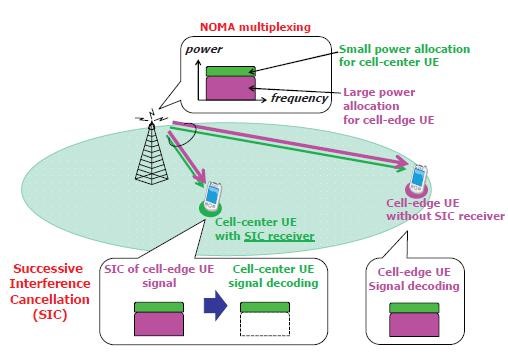
In Fig. 1 the architecture of downlink NOMA and SIC is presented where, the downlink NOMA scheme, multiplexes the users in power domain at the transmitter side whereas the SIC (Signal interference cancellation) occurs on the user equipment side or the receiver side. Consequently, this method is very optimal to implement at the system level, which supports the MIMO technology. [16] [17]
Figure 1: Downlink NOMA and SIC [17]
B.Proposed Solution based on Network Layer and Cloud level
Edge and Fog computing plays the vital role in next generation technologies which connects everything, everywhere. Technology like Tactile Internet requires ultra-low latency for communication which is only possible by 5G technology. Edge Computing as well as the Fog Computing can be used to reduce the E2E delay, low latency of communication and process the data closer to the user with the help multi-level cloud architecture [18]. With the help of edge computing in 5G as well as in Tactile Internet, it reduces the response times due to the locality of servers, which are in close proximity to the last mile network [19]. Apart from these discussed technologies, Software Defined Network and Network Function Virtualization also plays the important role in improvement of overall performance. Both of these technologies helps to solve the very critical and real time issues. It allows to use the SDN based centralized plane for the packet routing with reduced transmission and processing delays, which also helps to achieve the Ultra-Low Latency Communication [19]
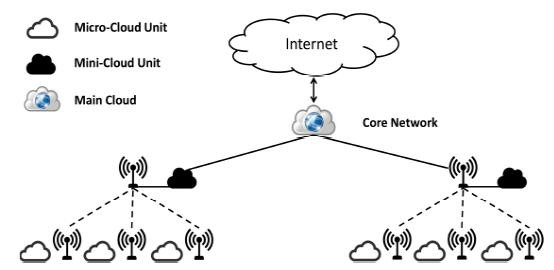
Figure2: Multi-level cloud for (TI) [2]
4.Summary of Analysis
As per analysis, the issues, and proposed solutions by most of the researchers are very comprehensive, which are aligned with objectives of Tactile Internet for the development of Smart Cities. However, this promising area will face some challenges in future too. So far, the paper discussed various issues, which are going to be resolved with the passage of time, such as reliability, low latency, delay and others prominent issues. This paper clearly states the issues that can appear for long time in future and still there is a room for improvement in order to propose comprehensive techniques that will optimize its performance not only at upper layers but also from the media access level
5.Conclusion
Future belongs to 5G revolution by supporting multiple application of tactile internet with low latency and high level of security and availability with maximum quality of service. For this, multiple challenges are needed to be addressed to achieve seamless audio and video traffic in order to get maximum throughput and energy efficiency.
In this paper, we discussed multiple issues, challenges and methods to overcome these challenges. Edge Computing, Multi-level cloud and use of NOMA for multiple access at downlink are the solutions to the various issues specially, the latency. Employing these solutions improves the TI system performance at the core level and as well as physical layer.
These technologies help the system reducing the latency efficiently by performing computations at the edge of User. Further, the spectrum efficiency could be improved by using the NOMA that performs the superposition of signals at the transmission BS and the signal decoding at the UE receiver. Future work can be extended to add more techniques on multiple layers in order to make TI operational and functional.
REFERENCES
- A. AIJAZ and M. SOORIYABANDARA, “The Tactile Internet for Industries: A Review,” PROCEEDINGS OF THE IEEE, Vols. 107,, 2019.
- A. A. Abdelhamied, A. Muthanna, I. Gudkova, A. Abuarqoub and A. Koucheryavy, “Development of Intelligent Core Network for Tactile Internet and Future Smart; Systems,” Journal of Sensor and Actuator Networks, 2018.
- “Challenges in Haptic Communications over the Tactile Internet,” IEEE Access, 2017.
- H. S. “Smart cities and internet of things,” Journal of Information Technology Case and Application Research, vol. VOL. 21, 2019.
- O. HOLLAND, V. PRASAD, A. AIJAZ, V. S. RAO and X. LIU, “The IEEE 1918.1 “Tactile Internet” Standards Working Group and its Standards,” PROCEEDINGS OF THE IEEE, Vols. 107,, 2019.
- M. Maier and A. Ebrahimzadeh, “Towards Immersive Tactile Internet Experiences: Low-Latency FiWi Enhanced Mobile Networks With Edge Intelligence [Invited],” Journal © 2019 Optical Society of America, vol. 11, 2019.
- M. S. A. Muthanna, M. M. A. Muthanna, A. Khakimov1 and A. Muthanna, “Development of Intelligent Street Lighting Services Model Based on LoRa Technology,” 978-1-5090-4865-6/17/$31.00 ©2018 IEEE, 2018.
- J. Pilz,, M. ,. Mehlhose, T. ,. Wirth, D. ,. Wieruch, B. Holfeld and T. Haustein, “A Tactile Internet Demonstration: 1ms Ultra Low A Tactile Internet Demonstration: 1ms Ultra Low,” 978-1-4673-9955-5/16/$31.00 ©2016 IEEE, 2016.
- J. Liu and Q. Zhang, “Offloading Schemes in Mobile Edge Computing for Ultra-Reliable Low Latency Communications,” IEEE Access, vol. 06, 2018.
- K. SOON KIM, C.-B. CHAE, Y.-C. KO, Y.-G. LIM and S. KIM,, “Ultrareliable and Low-Latency Communication Techniques for Tactile Internet Services,” PROCEEDINGS OF THE IEEE, Vols. 107,No. 2,, 2019|.
- V. H. and P. S. K. , “The Tactile Internet,” in International Conference on Innovative Mechanisms for Industry Applications, 2017.
- F. e. a. “Large-scale Offloading in the Internet of things.,” Proceedings of IEEE, 2017.
- K. e. a. “Software-Defined Networking: A Comprehensive Survey,” IEEE Communications Surveys & Tutorials, 2015.
- “https://www.statista.com/statistics/471264/iot-number-ofconnected-devices-worldwide/,” [Online].
- X. Wei, Q. ,. Duan and L. Zhou, “A QoE-Driven Tactile Internet Architecture for Smart City,” IEEE Network ( Early Access ), 2019.
- ” Z. Ding, Y. Liu, J. Choi, Q. Sun, M. Elkashlan, C.-L. I, and H. V. Poor, “Application of non-orthogonal multiple access in LTE and 5G networks,” IEEE Commun. Mag., vol. 55, no. 2, pp. 185–191, Feb. 2017″.
- “Siddiqi, M.A.; Yu, H.; Joung, J. 5G Ultra-Reliable Low-Latency Communication Implementation Challenges and Operational Issues with IoT Devices. Electronics 2019, 8, 981”.
- I. Tomkos, B. Shariati, J. M. José Manuel Rivas-Moscoso, D. M. Marom and D. Klonidis, “New Frontiers in Optical Communication Networking,” ICTON 2017 International Conference on Transparent Optical Networks.
- S. ,. Tanwar, S. ,. Tyagi, I. Budhiraja and N. Kumar, “Tactile Internet for Autonomous Vehicles: Latency and Reliability Analysis,” IEEE Wireless Communications , August 2019.
- S. K. Sharma,, I. ,. Woungang, A. Anpalagan, and S. Chatzinotas, “Towards Tactile Internet in Beyond 5G Era: Recent Advances, Current Issues and Future Directions,” IEEE COMMUNICATIONS SURVEYS & TUTORIALS (SUBMITTED DRAFT), 2019.